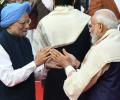
False and acrimonious debates such as Modi versus Manmohan might allow for victories that are political and partisan. But the real loser is the nation, India and Bharat, notes Arvind Subramanian, former chief economic advisor to the Modi government in its first term.

The National Company Law Tribunal (NCLT) has reserved its order on the merger of Zee Entertainment Enterprises and with Culver Max Entertainment (earlier known as Sony Pictures Networks India). The Mumbai bench of NCLT, comprising H V Subba Rao and Madhu Sinha, reserved the order on Monday, after hearing arguments from creditors who objected to the scheme including Axis Finance, JC Flower Asset Reconstruction Co, IDBI Bank, Imax Corp and IDBI Trusteeship. In December 2021, Zee Entertainment and Sony Pictures had agreed to merge their businesses.

Unlike any other business, banking is a turf where the captain's role is the most critical. Often a bank is defined by the personality of the CEO who runs it. Both HDFC Bank and Kotak Mahindra Bank are the creation of their CEOs, notes Tamal Bandyopadhyay.

The Reserve Bank on Thursday proposed tighter norms for treatment of wilful defaulters under which banks and other lenders will be required to examine all accounts with outstanding amount of Rs 25 lakh and more to see if the borrower is deliberately not repaying the loan. The central bank has issued a 'Draft Master Direction on Treatment of Wilful Defaulters and Large Defaulters' on which comments have been invited till October 31. According to Reserve Bank of India (RBI), the draft Master Direction expands the scope for regulated entities which can classify borrowers as wilful defaulters and broadens the definition of wilful default.

Finance Minister Nirmala Sitharaman on Tuesday held a review meeting on credit guarantee scheme with heads of public sector banks, and asked them to expedite loan disbursement under the Rs 3-lakh crore ECLGS for MSME sector, hit hard by coronavirus-induced lockdown. The meeting on Emergency Credit Line Guarantee Scheme (ECLGS) was held through video conference, and the minister appreciated the efforts of banks in execution of the scheme.

According to the NIPFP, there is the possibility that even if the banking system matures over time, some transactions could bypass the system so as not to pay the BTT.

'The focus needs to shift towards the ability to collect payments, particularly in tier-3 to tier-4 areas where acceptance is still lacking.'

Prime Minister Narendra Modi on Saturday announced the adoption of the New Delhi Leaders Declaration, a significant victory for India's G20 presidency that came amid increasing tensions and divergent views over the Ukraine conflict.
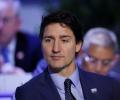
Canadian Prime Minister Justin Trudeau highlighted the importance of coordinated G20 leadership and action to uphold the rule of law and international law and strengthen democratic systems, as he participated in a virtual G20 Leaders' Summit hosted by India.
Multiple organisations of different kinds with overlapping goals would be a dream situation for those who believe in competition and innovation.

The Department of Post, Tech Mahindra, Videocon Group and stock exchange NSE have joined big corporates like Ambanis and Birlas to seek entry into banking business through newly created niche category of Payments and Small Finance Banks.

Since March 31, 2022, the PSBs' market cap has risen 43.7 per cent, from Rs. 7.29 trillion to Rs. 10.47 trillion. It's time for the government, the majority owner of public sector banks, to reap the benefit of the rally in bank stocks, recommends Tamal Bandyopadhyay.
These recommendations are based on interactions held by the Banks Board Bureau with eligible candidates from PSBs towards appointment against vacancies in PSBs for the period 2018-19

7 key areas that the Budget must address to re-energise the infrastructure sector, suggests Vinayak Chatterjee.

Indian society may be more advanced than we think it is, notes Ajit Balakrishnan.

Crypto assets should not be granted official currency or legal tender status, the much-awaited synthesis paper by the International Monetary Fund (IMF) and Financial Stability Board (FSB) has said ahead of the G20 leadership summit under India's presidency. However, the report has argued against a blanket ban on activities linked to crypto assets, explaining that such a move can be costly as well as technically demanding to enforce. Central banks should avoid holding crypto assets in their official reserve as they pose a risk to monetary and global financial stability, according to the synthesis paper.

The government has released the draft Micro Financial Sector (Development and Regulation) Bill, 2011, which seeks to make it mandatory for all microfinance institutions to be registered with the Reserve Bank of India, making it the sector regulator.

Coming Wednesday, Finance Minister (FM) Nirmala Sitharaman will present the 2023 Union Budget - the last full Budget ahead of the 2024 Lok Sabha elections. While India exited 2022 as a relatively bright spot in the global economy, the FM will endeavour to present a Budget that insulates India's economy against global headwinds and recession in advanced economies, while sticking to the path of fiscal consolidation. In this, she is being helped by her core team of trusted advisors.

More and more women are making their presence felt in jobs related to sciences, technology, and engineering across organisations.

Non-banking finance companies face renewed asset quality and liquidity risks amid a second wave of COVID-19, Fitch Ratings said on Thursday. These challenges are likely to increase if recent restrictions to contain the pandemic are expanded or prolonged, leading to greater economic and operational disruption, it added. The rating agency further said that an increase in the rate of infections and broadening of social distancing restrictions pose downside risks to its 12.8 per cent growth projection for the current fiscal.

Finance Minister Nirmala Sitharaman on Tuesday highlighted "significant reforms" undertaken by the government including National Monetisation Pipeline (NMP) and National Infrastructure Pipeline (NIP) as she met institutional investors in Boston. Sitharaman arrived in the US on Monday for a week-long trip to attend the annual meet of the World Bank and IMF in Washingon as well as G20 Finance Ministers and Central Bank Governors (FMCBG) meeting. During the official visit to the US, Sitharaman is expected to meet US Treasury Secretary Janet Yellen.

In eight cases, the banks would violate the minimum public shareholding norms if their promoter, the Government of India, infused capital as announced.
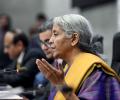
Let's wait for the monetary policy on February 8 -- to see how it complements the fiscal commitments, points out Tamal Bandyopadhyay.

Policymakers should aspire to restore the pre-Independence environment where the rupee was trusted and used all over South Asia, in Southeast Asia, in West Asia, and in East Africa, suggests Ajay Shah.
Demanding that willful default to banks be made a criminal offence under the Securitisation Act, the Delhi unit of All India Bank Employees Association on Monday said the corporate sector owes Rs 13,500 crore (Rs 135 billion) to banks and financial i

US President Barack Obama on Sunday affirmed his commitment to enhancing India's 'voice and vote' in global financial institutions like IMF.

The provisions in the FRDI bill do not modify current protections for depositors adversely at all, the ministry held, maintaining that these rather provide additional protections in a more transparent manner.

Benchmark BSE Sensex rose by 160 points on Thursday in choppy trade following gains in select banking and auto counters amid mixed global cues. The 30-share index gained 160 points to settle at 62,570.68 as 13 of its components advanced while 17 declined. The barometer opened lower but later gained momentum to touch a high of 62,633.56 in the day's trade.

Go First chief executive officer Kaushik Khona and tribunal-appointed interim resolution professional Abhilash Lal on Thursday reached out to the airline's staff, seeking their support for revival. While Khona said the company had taken all steps for the airline's revival, Lal put forward the view it would have to raise funds. Employee engagement took place a day after the National Company Law Tribunal (NCLT) admitted the airline's insolvency plea on Wednesday and ordered a moratorium on recoveries.

For the remaining projects, it is difficult to arrive at an estimate.

'In their over-enthusiasm to clean up the system, both the banks and the regulator should not forget that the key to the insolvency law is revival of companies -- recovery of bank dues is an offshoot of that,' points out Tamal Bandyopadhyay.

Retail investors now own a bigger slice of smallcap companies than at the start of 2023-24 (FY24), underscoring their growing conviction about investing in this red-hot space. Data from Capitaline shows mutual funds' (MFs') average holding in the National Stock Exchange Nifty Smallcap 250 rising to 9.26 per cent from 8.67 per cent during the first six months of FY24, with the number of companies with over 20 per cent MF holdings increasing from 24 to 28. In comparison, MF holdings in Nifty50 companies have gone up only marginally, from 9.67 per cent to 9.75 per cent.

There are about 5.7 crore small entrepreneurs.

Wall Street-correlated stock markets are facing the risk of correction, as Christopher Wood, the global head of equity strategy at Jefferies, conveys to investors in his latest edition of GREED & fear. Rising crude oil prices, which are nearing $100 a barrel (Brent), pose a threat to the global central bank's battle against inflation and have led to a re-evaluation of its exposure to Indian stocks. "The potential for more US Federal Reserve (Fed) rate hikes, combined with the risk that monetary tightening finally bites as regards the economy, remains a risk for Wall Street-correlated world stock markets. "There is also the oil factor. This is why GREED & fear continues to believe the pain trade is down. "Areas in Asia, such as Indian midcaps, which have already done very well, are at obvious risk of some profit-taking," writes Wood.

'The new ceiling will cover around 93 per cent of all deposit accounts, up from 90 per cent earlier,' notes Tamal Bandyopadhyay.

Industry players believe the new DFI model will be initially risk capital, which will then be used to mobilise additional resources from development agencies such as World Bank.

'There are occasions when the prices of individual items like food raise inflation; then supply-side measures must be taken.' 'But if there is continued inflation, it means liquidity is aggravating the situation.'
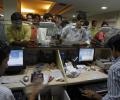
State Bank of India is also expected to tap the markets this year

India's unabated tryst with Russian crude oil is slowly coming to an end. The time has come for Indian refiners to navigate, creatively, the choppy waters of the post-honeymoon period, and for Indian policymakers to take cognisance of the broader impact on India from the spillover of the Russian crisis - after Washington's warning to transgressors last week. Shipments from Russia to India have averaged over 1.8 million barrels a day since February, according to data from Paris-based market analytics firm Kpler. But much of the crude shipped to India was non-sanctioned because it traded below a price cap set by the US led G-7 nations in December.

'For years, the RBI has been warning banks on probable frauds in bank guarantees and advised them to exercise due care.' 'PSB staffers feel their jobs are secured, hence there is no need to be vigilant and exercise financial prudence.'
